There's no single "best" miles card for everyone — it depends on how you spend. But most months aren't wildly specialised, so we ran a fairly typical S$3,000 month through the numbers to see what actually wins.
Milestacker · Card data checked 22 August 2026 · 10 cards ranked
There's no such thing as the one best miles card in Singapore. It genuinely depends on how you spend. But most people don't have a wildly specialised month — some dining, some groceries, a bit of shopping online, the usual bills — so that's the basket we used below.
The cards that come out on top here aren't the ones with the flashiest headline rate. They're the ones whose bonus covers more than one of your habits at once, because a bonus that only fires on one narrow thing doesn't have much to work with on an ordinary, mixed month.
Worth flagging early: a few cards further down this list ask nothing of you at all — no minimum spend, no tapping your phone a certain way, no online-only rule, just a flat rate on everything. They rank lower mainly because that flat rate is modest, not because they're bad cards.
The month being ranked
A typical S$3,000 month
Dining
S$600
Shopping
S$600
Groceries
S$500
Bills & utilities
S$400
Other
S$300
Transport
S$250
Hotels & travel
S$200
Entertainment
S$150
Total
S$3,000
Roughly the shape of general household spend, with a little of everything, so no single card's narrow bonus dominates by accident.
Put in your own numbers and this order will probably shuffle — sometimes a lot. That's expected: it just means your spending doesn't look like this month.
The three that earn most
1
UOB
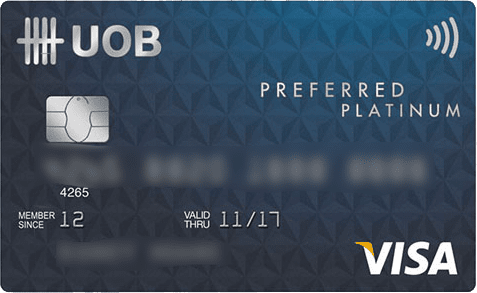
UOB Preferred Visa Card (formerly Preferred Platinum Visa)
UOB Preferred Visa Card (formerly Preferred Platinum Visa)
UOB · mobile contactless & online
Earns
5,520
miles a month
Effective
1.84
mpd, best rate 4
The catch
Caps at S$600/month
A similar idea to the card above, just smaller: the bonus is mobile-wallet taps or selected online shopping, each capped at S$600 a month. Tap the physical card instead of your phone and you're straight back to the 0.4 mpd base rate — the single easiest way to lose out on this one.
This card's bonus splits into two separate buckets — spending overseas, and tapping your phone (not the physical card) for local purchases, petrol or transit — and each one needs its own S$1,000 a month before it pays out, capped at S$1,200 apiece. On a mixed month like this, that combination beats everything else here, even though most of an ordinary month's spending still falls into neither bucket.
Almost everything you buy online earns the bonus here, with two carve-outs worth remembering: travel bookings and bill payments both fall back to the base rate, even though most people would call both "online" spending. You also need to type your card number in directly at checkout — paying with Apple Pay or Google Pay earns nothing extra.
Every card here pays a lot less once its cap or minimum spend gets in the way. The card at the top just gives your ordinary spending more ways to qualify in the first place.
What trips people up
A flat-rate card might just suit you better
If your spending doesn't concentrate around one habit — a lot of tapping, or a lot of online shopping — a plain uncapped card further down this list can beat a flashier one, simply because it asks nothing of you to earn its rate.
Two buckets means two minimum spends
Cards that split their bonus into separate categories usually gate each one separately too. Miss one month's threshold in a bucket and that whole bucket earns nothing, even if the other one paid out fine.
Mobile wallet, not the physical card
A lot of these bonuses only fire when you tap your phone, not the card itself. It's an easy habit to slip on, and slipping on it usually means falling straight to the base rate.
Your own month can flip this order
A S$1,000 cap barely matters in a light month and bites hard in a heavy one. This ranking is only true for the basket shown — a bigger or smaller month can genuinely change who wins.
Why the top cards aren't the ones with the highest headline rate
Every card on this page advertises up to 4 mpd somewhere in its marketing. What actually separates them is how much of an ordinary month's spending can reach that rate at all — a card that bonuses one narrow habit earns its best rate on very little of your month, however good the headline sounds.
That's why the top spot goes to a card whose bonus splits across two different habits instead of one big number. More of an ordinary S$3,000 month has something to qualify with.
What this ranking leaves out
Annual fees, foreign transaction fees and sign-up bonuses aren't part of this number. A big welcome bonus can make an average card look brilliant for exactly one year, and folding that into an ongoing monthly rate would misrepresent both.
Minimum-income requirements matter too, and they're shown on each card rather than baked into the ranking — a few of the flat-rate cards near the bottom of the full ranking need S$120,000 a year in income just to apply.
Questions people actually ask
Why isn't there one clear winner for everybody?
Because the bonus structures reward different habits, and everyone's month looks a bit different. Someone who shops online a lot will do better on a different card than someone who mostly swipes at the till — this page just shows what wins on one fairly ordinary basket.
Should I just get the top card on this list?
It's a reasonable starting point if your spending looks roughly like the basket below. But the bigger lever isn't which single card you pick — it's whether your habits, like mobile taps or online checkout, actually line up with what the card bonuses.
Why do some cards have no bonus at all?
Those are flat-rate cards — the same modest rate on everything, uncapped, no conditions. They rank lower here because their flat rate is lower than a bonus rate, but they're also the easiest cards to actually use well, since there's nothing to remember.
How up to date is this?
These numbers come from the same data our planner uses, and every rate that matters is checked against a dated source. Card terms in Singapore shift a few times a year, so it's always worth double-checking with the bank before you apply.
How these numbers are worked out
Every rate is quoted in KrisFlyer miles, with each card's points-to-miles conversion already applied. That makes cards comparable to each other, but it means these figures sit below the headline rates issuers and review sites publish, which are usually quoted in the card's own points or at its best transfer partner.
The ranking is produced by running the same engine the planner uses, with one card held and the basket above as the month's spend. Monthly bonus caps, minimum-spend gates and category exclusions are all applied, so a card whose bonus runs out halfway through the month ranks on what it actually earned.
Not included: annual fees, foreign transaction fees, sign-up bonuses, and any relationship tier you have to hold a balance to unlock. Card terms change often — confirm with the bank before applying. Full disclaimer.
This ranking used a made-up month. Yours is different.
Put in your real numbers and Milestacker will show you which card — from the ones you already have, plus whatever you're missing — actually earns you the most. Free, no login, nothing leaves your browser.